 Gabriel Abreu
Truth has a security budget


$23.75 million moved through Ostium's oracle-authority path.
On Polymarket, a market with more than $150 million in volume resolved through UMA, where nine wallets control roughly half the voting power platform-wide.
Different mechanics, same exposure: too much value can depend on too little authority.
Oracle security comes down to one question: how much value can a truth mechanism move, and how hard is it to corrupt?
Case 1. The vault did exactly what it was told
A registered forwarder submitted false but fully authorized price reports into Ostium's vault. The vault settled against them.
$23.75 million moved in minutes, and Blockaid caught the mechanism as it fired.
A hacktrail reconstruction by @Not_A_De_Gen laid out the full sequence step by step.
The root cause stays open: a stolen key, or an authorization someone misused. The analyst's own words: signature verification "appeared to work exactly as deployed."
Ostium's July 19 update confirmed the incident but did not establish the cause.
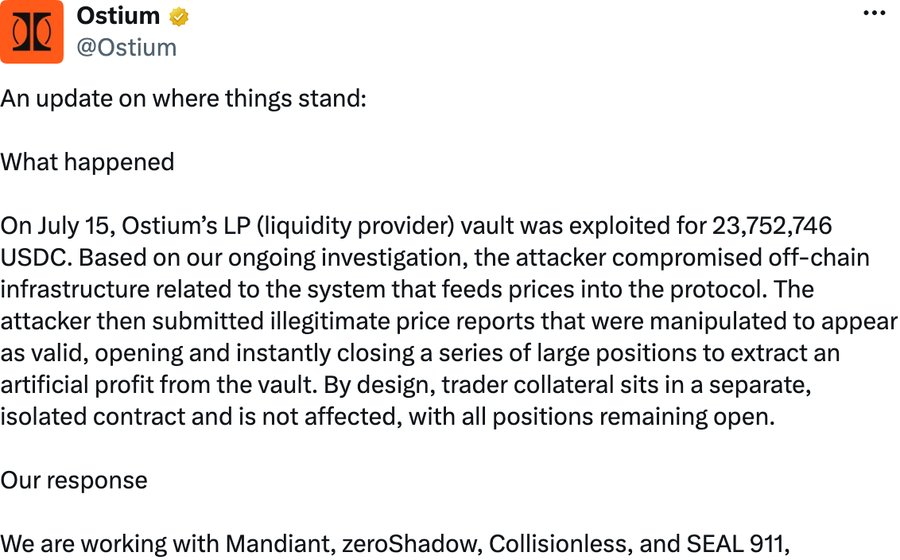 Ostium's July 19 update
View post on X
Ostium's July 19 update
View post on X
One authorized reporting path moved that money, and the public record still does not establish what was compromised or how.
Case 2. The vote said yes anyway
Polymarket's own rules required a permanent peace deal between the US and Iran by June 15.
A 60-day interim framework arrived instead. The rules excluded exactly that: a temporary deal doesn't count.
UMA's token-holder vote resolved YES anyway, at more than 99.7% of voting power.
The market resolution rules left no room for that outcome. Traders positioned around the rules' literal permanent-peace requirement lost their bets.
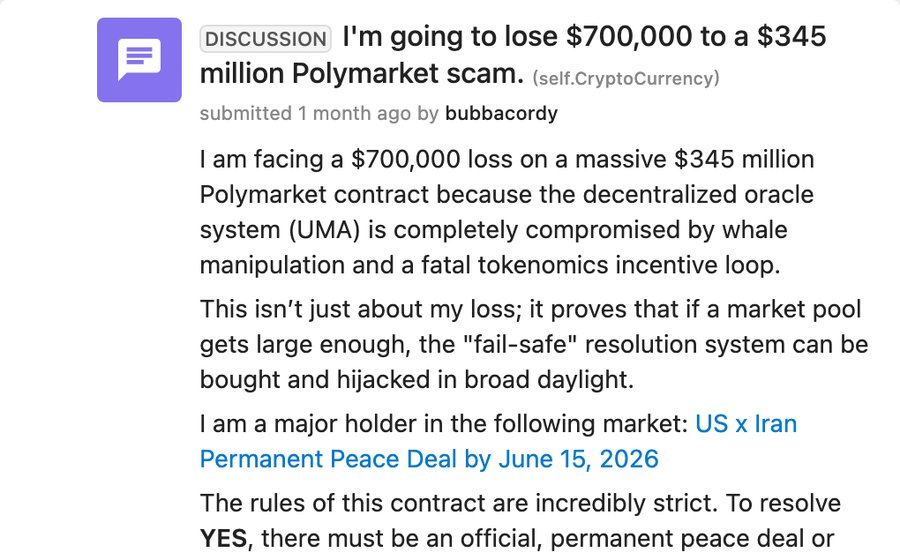 A trader's account of the dispute
View post on Reddit
Contemporaneous participant account. Its $700,000 and $345 million figures are the author's claims, not measurements used in this article.
A trader's account of the dispute
View post on Reddit
Contemporaneous participant account. Its $700,000 and $345 million figures are the author's claims, not measurements used in this article.
More than $150 million in volume had flowed through the market by resolution.
Bloomberg reported that nine wallets control roughly half of all UMA voting power across the platform, almost always voting together, almost always winning.
Nobody has shown which wallets decided this vote. The platform-wide pattern is the finding that holds.
A voter who also held the winning position could receive both the market payout and separate UMA voting rewards.
Narrow authority is the shared risk
Ostium is an authorization problem. A registered forwarder supplied false reports through an authorized path, and the vault used them for settlement.
Polymarket is an incentive problem. A voting bloc's financial interest can point away from what the rules say.
The mechanisms differ, but the exposure has the same shape: large amounts of value hinge on narrow authority sets in both cases.
Neither case yields a measured cost to corrupt the outcome.
That ratio is the central design question both markets still owe a real answer to.
Make the security match the money
How much value can the oracle move if it's wrong?
That number sets the security budget.
A protocol whose oracle path can move $23.75 million in minutes needs authorization controls built for that scale.
A narrow reporting path or concentrated voting power creates an obvious target for attackers and self-interested actors.
Multi-party thresholds, key rotation on a schedule, live monitoring for anomalous reports, and a fast revocation path shrink that target.
Voting systems carry a parallel obligation.
Dispute bonds and participation requirements should scale with the value a vote can decide.
Voter concentration and conflicts belong in the open, tied to named wallet addresses.
Assume the authority fails anyway, and someday it will. Settlement limits cap how much any one report or resolution can move.
Circuit breakers pause settlement when a report looks nothing like the market it describes.
A public authority map, naming who can move what, lets anyone see the exposure before it gets used against them.
The security behind a fact should scale with the value that fact can move.
Liked this? You'll always get my POV here. Follow me on X at @gabe_onchain or keep reading my blog posts right here.